

There’s a photo of me at seventeen, leaning against a chain-link fence behind the high school gym. I’m wearing a pair of black skinny jeans, a white V-neck T-shirt, and a hoodie faintly pocked with cigarette ash from days when it wasn’t cool to vape. In the snapshot, I’m slouchy in that deliberate way peculiar to teenagers—attempting, I suppose, to appear unbothered by the world around me. The jeans were tight enough to leave semi-permanent impressions on my calves. At the time, I believed they were sophisticated. I believed I was sophisticated. The cut was sharp, the silhouette slender. I hadn’t yet considered that fashion, like culture, operates more like a pendulum than a straight line.
I didn’t know I was dressing for 2009.
Now, more than a decade later, I find myself earnestly trying on a pair of
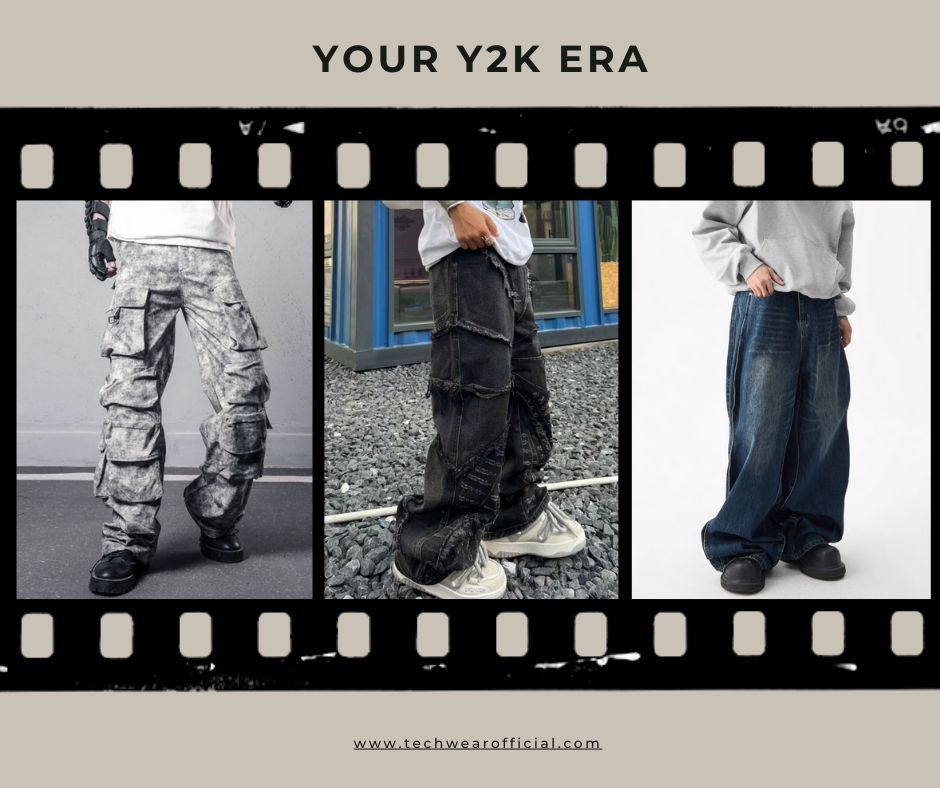
baggy cargo pants y2k in the dusty back corner of a Brooklyn vintage store called “Slacker’s Rummage.” Nothing about them fit “properly.” And somehow, that’s the point.
They were khaki—faded in that very specific way that only early 2000s garments can achieve, sun-bleached but oddly resilient. They featured unnecessary zippers, enough pockets to store the entire contents of my kitchen junk drawer, and a kind of post-grunge audacity that made me feel both ridiculous and twenty-two years old again. Which, obviously, I’m not.
I didn’t buy them right away. I walked down the street, passed a sandwich shop where a group of impossibly stylish teenagers laughed into iced matcha lattes. The girls—if you can call them girls, though their poise suggested something far more curated—wore low-rise denim skirts layered over leggings, Prada mini bags slung like armor, and baby tees with ironic slogans. They were very much the new wave of y2k girls: bold, referential, and somehow exempt from time’s effects. One of them had her pants—baggy and brilliant, a cousin of the pair I’d just tried on—tucked into lace-edged socks and heels.
That night, I went back to the store. The pants were still there. I bought them.
To understand what is happening with fashion right now, you have to understand what was happening then—not in couture ateliers or runway shows, but in living rooms with boxy televisions and overexposed flash photography. We are reliving a time that, for many of us, never quite felt iconic until enough years had filtered it through nostalgia’s Instagram-based haze.
The early 2000s had a style all their own: chaotic, layered, a little careless. What we wore wasn’t aestheticized back then—it was just clothing. Y2k pants, in particular, came in with the same kind of brash confidence as the Motorola Razr and the Hot Topic impulse buy. These were pants that didn’t ask for you to accessorize them, because they already came laden with straps, toggles, secret velcro compartments.
Back then, having too many zippers wasn’t a warning sign—it was a flex.
Recently, I asked my younger brother—a style connoisseur who discovered the genius of oversized silhouettes long before TikTok validated them—what he thought about my renewed interest in cargo pants. He raised an eyebrow.
“Oh, you’re going baggy now?” he asked, suppressing a smirk. He himself was wearing the y2k pants mens version: charcoal-gray, cinched at the ankle, with an intentional bulk that looked like it had been approved by a streetwear oracle. “Yeah man,” he nodded thoughtfully, “It’s about anti-silhouette now. Post-skinny. Clothes with space, not definition.” He sipped his dark roast. “It’s also about utility. You can carry everything in these. Emotional baggage included.”
I told him I had tried on a pair of Balenciaga pants once—just for fun. They were so heavy I felt briefly like a middle schooler in snow gear: padded, oversized, and slightly incapable of dignity. “Those pants cost more than my rent,” I said.
He shrugged. “Well, that’s the thing. Style gets ironic at the top.”
And maybe that’s the paradox of Y2K fashion’s resurgence. It was born not from luxury, but from accessibility—everything puffed, overdesigned, weirdly cyber-futuristic. You didn’t need a stylist in 2001. You needed a mall and a group of friends willing to tell you when your butterfly clips were crooked. Now, some brands are regenerating that iconography with designer labels—versions of baggy pants y2k kids wore for $30 now priced at twenty times that. A commercial remix, like a DJ sampling your childhood.

Sometimes I stare at my closet and wonder when a pair of pants became an existential choice. The y2k cargo pants I picked up last week now hang next to my sleek, post-2015 minimalist trousers. Pants which, up until a few months ago, I thought would last forever. “Timeless,” they called them. It turns out nothing is timeless.
My friend Clara, who works in fashion merchandising and once declared war on low-rise anything, now texts me links to faux-vintage utility pants at 2 a.m. “These feel correct,” she writes. “I want to wear something that doesn’t try so hard. Or… tries so hard it loops back around to not trying.”
Maybe that’s the true charm of the Y2K style moment: it doesn’t pretend not to care. It is maximalism in a cynical age, a return to the clunky optimism of flip phones and early internet. We once called those years “the future.” Then the future passed, quietly at first, then all at once.
And now, here we are. Wearing our past on our hips.
I took the subway into Manhattan last Thursday wearing the cargo pants again, paired with a vintage windbreaker and my old college T-shirt. I walked past mirrored windows and tried not to look at my reflection. But I caught it anyway. In the moment, I looked ridiculous, a little larger than life—and strangely proud of it.
If fashion is a carousel of memory, maybe growing older just means learning to lean against the rotation—one well-pocketed pant leg at a time.
