
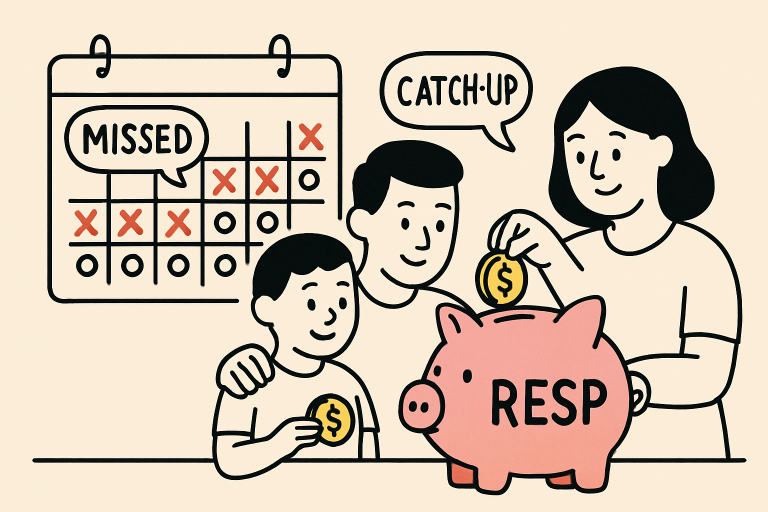

Key Takeaways:
- Understanding the flexibility of RESP contributions allows families to maximize educational savings.
- Utilizing catch-up contributions can help recover missed Canada Education Savings Grant (CESG) benefits.
- Strategic planning ensures adherence to contribution limits and maximizes government grants.
Table of Contents
- Understanding RESP Contribution Limits
- The Role of the Canada Education Savings Grant (CESG)
- Catching Up on Missed Contributions
- Strategies for Maximizing RESP Savings
- Avoiding Over-Contribution Penalties
- Real-Life Example of Catch-Up Contributions
Maximizing Registered Education Savings Plan (RESP) contributions is crucial for parents aiming to secure their child’s post-secondary future. However, life’s financial priorities can shift, causing many families to miss some annual contributions over the years. The good news is that the RESP system offers avenues to catch up RESP savings and grants, turning missed opportunities into future educational security.
The RESP isn’t just flexible in its structure it’s built to accommodate the real-life needs of Canadian families. With strategies for catch-up, you can still take advantage of the government grants without feeling penalized for earlier savings gaps. By understanding the mechanics of the RESP contribution room, it’s possible to recover lost ground and ensure your child benefits from the maximum available assistance.
The key is to become familiar with how the Canada Education Savings Grant (CESG) works and how contribution limits are calculated. When you align your savings plan with the RESP’s rules for carry-forward grants, you can optimize both personal savings and government support.
For detailed information on RESP benefits and long-term planning, resources like Canada.ca’s RESP guide can help inform your decision-making as you optimize your strategy.
Understanding RESP Contribution Limits
RESP accounts are designed to be flexible but include strict rules on maximum funding. While there’s no set annual limit to contributions, there is a lifetime cap of $50,000 per beneficiary. Contributions can come from parents, grandparents, or other loved ones as long as the total does not exceed the cap. All contributions are made with after-tax dollars, but earnings generated in the account grow tax-free until withdrawal, giving a powerful compounding effect as long as funds stay within the plan.
By respecting these boundaries, you help ensure the growth of your educational savings and guard against penalties that could diminish your returns.
The Role of the Canada Education Savings Grant (CESG)
The CESG acts as a foundation for RESP growth. For every $1 you contribute annually, the federal government adds $0.20, up to $500 per year per beneficiary. To access the maximum annual CESG, you should contribute $2,500 yearly. The lifetime maximum CESG a beneficiary can receive is $7,200, significantly increasing the savings available for education costs.
If you miss contributing in any year, you can claim the grant for previous years, which can help families who may have gotten a late start or faced interruptions in their savings.
Catching Up on Missed Contributions
The RESP rules allow you to catch up on missed CESG grants by leveraging unused contribution room from prior years. You do not contribute the annual CESG maximum each year, and the unused grant room carries forward indefinitely. During catch-up, you can claim up to $1,000 in CESG per year by contributing up to $5,000 in a single year, $2,500 is attributed to the current year, and $2,500 is used to recover one previous year’s grant money. This process allows you to diligently recoup missed government support and get your RESP back on track.
However, it is important to pace your contributions and plan catch-up years so you don’t exceed the $50,000 lifetime limit or trigger over-contribution penalties.
Strategies for Maximizing RESP Savings
- Start Early: The earlier you start saving, the more time your money has to grow thanks to tax-sheltered returns. Compounding can make a significant difference over 15 to 18 years.
- Consistent Contributions: Setting up automated monthly contributions, such as $210 annually, ensures you meet the $2,500 annual target for the maximum CESG.
- Leverage Catch-Up Years: If you’ve missed contributions, make targeted, larger contributions to claim catch-up CESG. Planning is key, as you can only claim one year’s missed grant per calendar year and the current year’s grant.
- Monitor and Adjust: Review your RESP regularly to maximize available contributions and ensure your savings plan is on track for your child’s anticipated educational timeline. Resources like CST Spark’s RESP maximization guide offer timely advice for optimizing your approach each year.
Avoiding Over-Contribution Penalties
It’s critical to be aware that excess RESP contributions above the $50,000 per beneficiary cap result in a 1% monthly penalty on the overage, applied until the excess is withdrawn. Over-contributions can happen easily, especially if multiple relatives are contributing or during catch-up years, so diligent deposit tracking is essential. Review all RESP transaction records or speak with your financial institution if you’re unsure about your current balances.
The Canada Revenue Agency (CRA) offers detailed guidelines for RESP contribution tracking that can help you avoid costly errors.
Real-Life Example of Catch-Up Contributions
Imagine a parent who, due to financial strain, didn’t contribute to their child’s RESP for the first two years after birth. By the third year, the parent can save $5,000 to claim $1,000 in CESG ($500 for the year’s contribution plus $500 catch-up for one missed year). Continuing annual contributions of $5,000 lets them recover missed grants from previous years one by one, until their child’s grant entitlement is fully maximized, even if they started late. This approach can sometimes let a family catch up seamlessly when their child is ready for post-secondary studies.
RESP catch-up rules offer families a practical roadmap for ensuring educational savings stay on track, even after a slow start. With careful planning and attention to annual limits and grants, your child’s future educational opportunities can remain fully funded.
