
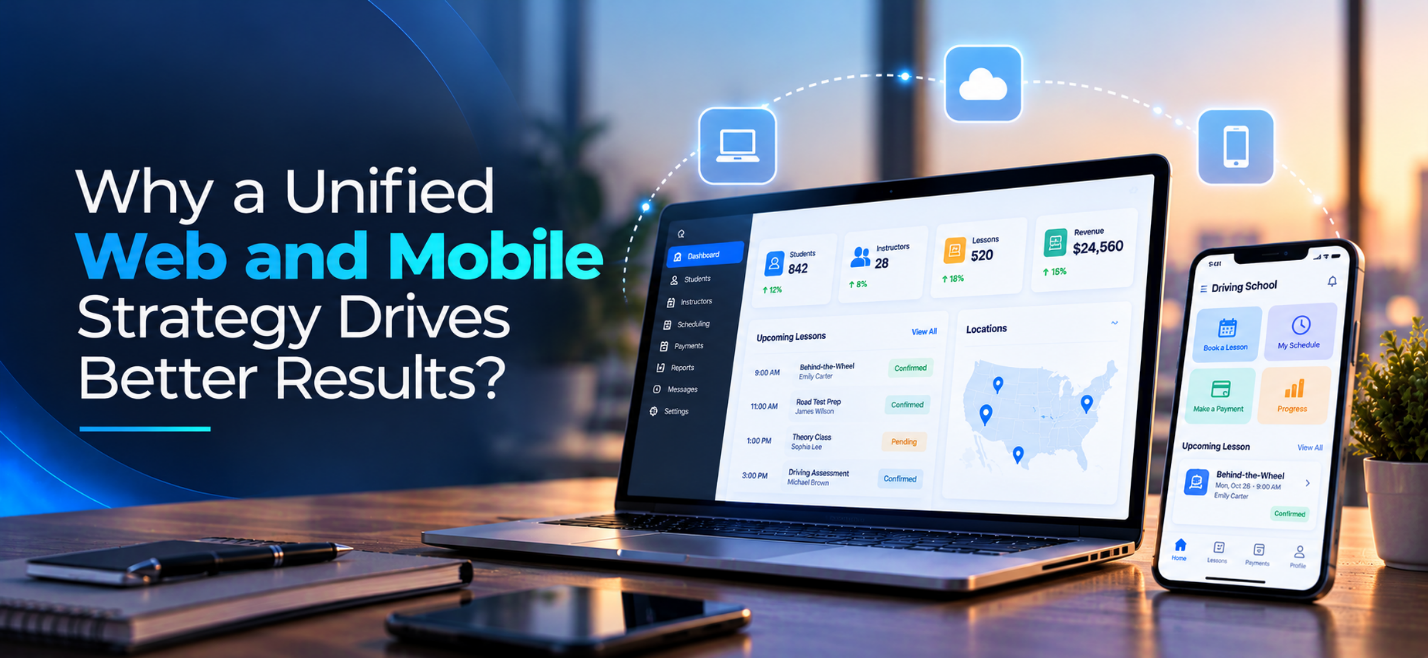

The Hidden Costs of Disconnected Digital Platforms
Many businesses begin their digital journey with a website and introduce a mobile application later. Since these platforms are often developed by different teams, they may operate independently. Although both initially serve their purposes, disconnected systems can create difficulties as customer demand increases.
For instance, customers might encounter different account information across devices, while employees struggle with delayed order updates or inconsistent pricing. Maintaining separate databases and business processes also increases development expenses.
A unified approach addresses these challenges by connecting digital platforms through shared infrastructure. Businesses investing in custom web application development services can establish a reliable foundation that supports both current requirements and future mobile experiences. This reduces unnecessary duplication while helping companies manage their operations more efficiently.
Essential Qualities of Enterprise-Grade Applications
Enterprise-grade software is defined by its ability to support demanding business operations, not simply by the organization’s size. When companies invest in custom mobile application development services, they should consider how the application will connect with existing systems and support long-term objectives.
Several characteristics contribute to dependable enterprise applications:
- Scalability: The infrastructure should accommodate increasing users, transactions, and business activities without requiring frequent reconstruction.
- Security: Consistent authentication, encryption, access permissions, and regular assessments help protect sensitive information across platforms.
- Performance: Efficient APIs, caching, and optimized data transfers contribute to responsive experiences on different devices.
- Reliability: Monitoring systems, recovery procedures, and carefully managed deployments help reduce service interruptions.
- Integration: Connections with payment platforms, CRM systems, and business management tools simplify information exchange across departments.
These capabilities are particularly valuable when web and mobile applications depend on shared business information.
Building a Foundation for Sustainable Growth
Selecting an Appropriate Application Architecture
Application architecture influences how efficiently a company can introduce new capabilities. A monolithic structure combines major functions within one application, while microservices divide functionality into smaller, independently managed services.
Neither approach is universally superior. A modular monolith may suit businesses seeking simpler maintenance, whereas microservices can offer greater flexibility when particular functions require independent deployment or scaling.
The important consideration is keeping essential business logic accessible to both web and mobile interfaces. Shared services can minimize inconsistencies and prevent teams from implementing identical functions separately.
Using Cloud Technology Effectively
Cloud infrastructure provides businesses with flexible computing resources, managed databases, and deployment options. Platforms such as AWS, Microsoft Azure, and Google Cloud can support changing operational requirements.
However, cloud services do not automatically guarantee uninterrupted availability or lower expenses. Proper configuration, monitoring, cost management, and recovery planning remain necessary.
When implemented thoughtfully, cloud infrastructure allows connected applications to expand without repeatedly replacing their underlying systems.
Making Better Decisions Through Connected Data
Customer activity frequently extends across multiple devices. Someone may explore services through a laptop before completing a purchase using a smartphone.
When both platforms maintain separate records, businesses may struggle to understand this journey. A connected data environment can provide clearer insights into purchasing behavior, customer preferences, and service performance.
Such information supports more informed planning while appropriate privacy safeguards help maintain responsible data management.
Preparing for Automation and Artificial Intelligence
Automation and AI solutions perform more effectively when business information is organized and accessible.
Connected applications can simplify the introduction of automated notifications, intelligent recommendations, customer support tools, and predictive analytics. Shared APIs also make it easier to integrate relevant capabilities across different channels.
Nevertheless, businesses should evaluate data quality, accuracy, and security before introducing automated decision-making systems.
Common Development Mistakes to Avoid
Focusing Only on Immediate Requirements
Some organizations prioritize short development schedules without considering future maintenance. Although this may reduce initial expenditure, poorly planned systems can become expensive to modify.
Temporary integrations, duplicated functions, and limited documentation often create difficulties when applications expand. Considering long-term operational needs during initial planning helps reduce these risks.
Overlooking Scalability During Planning
Scalability does not require businesses to build unnecessarily complicated systems from the beginning.
Instead, developers should establish clear system boundaries, suitable database structures, and reliable communication interfaces. These decisions make it easier to introduce additional functionality when demand grows.
Choosing Technology Without Proper Evaluation
Selecting a framework solely because it is popular can lead to maintenance and compatibility problems.
Businesses should examine performance requirements, developer expertise, integration needs, and future support. Cross-platform technologies such as Flutter and React Native may suit certain projects, while native development may be more appropriate for specialized device functionality.
Practical Steps for Developing Future-Ready Applications
Establish Clear Goals Before Development
Successful projects begin with a thorough understanding of business objectives and customer expectations.
Teams should identify which activities move between web and mobile platforms, what information needs to remain consistent, and where platform-specific functionality is necessary.
A structured discovery process can reveal potential integration difficulties before significant development resources are committed.
Choose a Development Partner Strategically
A suitable development partner should understand more than individual application features. Experience with API development, system integration, security, testing, and ongoing maintenance is equally important.
NewAgeSysIT, a custom software engineering company headquartered in New Jersey, works with businesses across the US market on web development, mobile applications, cloud solutions, and AI integration. This combination of technical disciplines reflects the broader expertise required when organizations want connected digital experiences.
Continue Improving After Launch
Application development does not end when a product becomes available.
Businesses should regularly assess loading speed, error reports, customer feedback, and application stability. Planned updates, testing procedures, and architecture reviews help maintain performance while supporting changing requirements.
Continuous improvement also allows companies to address technical limitations before they become major operational problems.
How Unified Systems Improve Business Operations
Consider a hypothetical home maintenance company using a website for customer appointments and a separate mobile application for technicians.
When booking information is transferred only at scheduled intervals, technicians may receive outdated details. This can cause appointment conflicts, administrative delays, and customer dissatisfaction.
By introducing a shared backend and secure API connections, the business could allow both applications to access updated booking information.
Technicians would receive changes more promptly, while office employees could coordinate scheduling and invoicing through connected services.
The company could subsequently introduce customer notifications or location tracking without rebuilding its entire digital infrastructure.
Although implementation would still require appropriate testing and monitoring, the shared architecture would provide a stronger foundation for expansion into additional service areas.
Conclusion: Build Connected Systems for Growth
A unified web and mobile strategy helps businesses manage information consistently, simplify development, and deliver more dependable customer experiences.
Rather than maintaining disconnected applications, organizations can invest in shared services, flexible infrastructure, and coordinated development processes.
Businesses should assess their existing architecture before introducing major features or expanding into new markets. Understanding current limitations makes it easier to prioritize improvements and avoid unnecessary reconstruction.
Ultimately, well-planned digital systems give companies the flexibility to respond to changing customer expectations while supporting sustainable long-term growth.
Read more : https://spiritualmeaningacademy.com/how-can-a-multi-device-charging-station-simplify-your-tech-setup/
