

Table of Contents
- Introduction
- Understanding Room Acoustics
- Optimal Monitor Placement
- Implementing Acoustic Treatment
- Calibrating Your Monitors
- Effective Use of EQ
- Controlling Dynamics with Compression
- Utilizing Reverb and Delay
- Referencing Multiple Systems
Mixing in a compact studio can be an intimidating prospect, but with the right approach, your mixes can sound just as clean and professional as those created in larger spaces. Acoustic problems, tight space, and resource limitations present unique challenges but modern strategies and smart gear choices can help turn even the smallest room into a reliable mixing environment. For those who want to equip their home studio with trusted sound tools, exploring options from Bose Professional Australia can be an excellent starting point for achieving clarity. Adequate mixing in small studios is achievable by focusing on room acoustics, monitor placement, and utilizing EQ and effects. Notable producers demonstrate that quality sound relies on technique rather than the size of the space. Key considerations include understanding sound reflections and standing waves, which help avoid muddiness and maintain clarity across various playback systems. A successful mix also involves applying best practices in acoustics, such as calibrating monitors and using consumer headphones for reference.
Understanding Room Acoustics
Small rooms dramatically color sound by amplifying certain frequencies and diminishing others, making accurate mixing a challenge. Common problems include standing waves caused by sound bouncing between parallel surfaces and intrusive reflections that blur detail. Bass frequencies, in particular, can build up in corners, causing mixes to sound “boomy” or overly muddy. Acknowledging these acoustic challenges allows you to compensate with placement, treatment, and carefully chosen listening levels. Many engineers recommend listening at lower volume levels in problematic environments, as loud playback can exaggerate the issues caused by a small space.
Optimal Monitor Placement
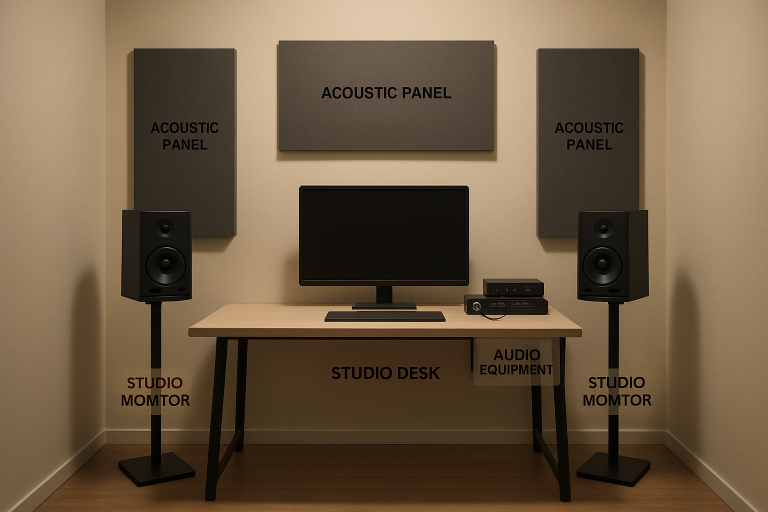
Your speakers’ position is as important as their quality. To achieve the best stereo imaging and frequency response in your space, arrange your monitors and your listening position in an equilateral triangle. The tweeters should sit at ear level, and the monitors should be positioned a distance from the walls to avoid boundary buildup, which can skew your perception of bass and midrange frequencies. It’s also wise to angle the monitors (toe-in) towards your primary listening spot, which helps reduce sidewall reflections and achieves a “sweet spot” for accurate mixing. Even in smaller rooms, a few inches away from reflective surfaces can make a difference.
Implementing Acoustic Treatment
Strategic acoustic treatment is the cornerstone of a reliable mix space. Place bass traps in all available corners to tackle low-frequency build-up. Use broadband absorption panels at first reflection points these are usually to your sides, ceiling, and behind your monitors and listening position to tame flutter echoes and early reflections, which can confuse your perception of stereo width and reverb. Diffusers are also useful for breaking up high-frequency energy, stopping your studio from sounding overly ‘boxy’ or dead. If purpose-built panels are out of reach, heavy curtains, thick rugs, and even filled bookshelves can significantly improve your acoustics.
Calibrating Your Monitors
Once your room is set up, calibrate your monitors for accurate reference. Tools like Sonarworks SoundID Reference or free options, such as Room EQ Wizard, can analyze your space and apply corrections via special EQ curves. Calibration helps neutralize frequency areas where your room exaggerates or diminishes certain sounds, letting you trust what you hear.
Effective Use of EQ
Equalization is your primary tool for clarifying each instrument’s place in the mix. Use high-pass filters on most tracks, except for bass and kick drum, to prevent low-frequency clutter. Identify and carefully cut resonant or ‘boxy’ midrange areas (typically around 200-500 Hz) and harsh sibilance (2-5 kHz) with narrow Q values subtlety is crucial.
Boosts should be gentle and intentional, often less than 3dB, to retain natural character. Trust your ears, but verify with reference tracks to stay on target. The aim is separation and clarity not surgical perfection.
Controlling Dynamics with Compression
Compression lends cohesion and control to uneven performances. Gentle compression smooths out vocals and dynamic instruments without robbing them of life. Try parallel compression on drums or guitars to add body while preserving attack. Always match your attack and release times to the source material for punchy yet transparent results.
Too much compression can kill dynamics and energy, so use your meters and ears: listen for unwanted pumping or dullness, and dial in just enough control to bring out presence and consistency.
Utilizing Reverb and Delay
Space is essential, especially in a small, untreated room, but excessive reverb can drown out your mix. Favor short reverb tails and consider plate or room reverb types for vocals and snares. Use delays to add depth and width instead of relying solely on reverb timed delay throws or subtle slapbacks can make elements pop out without muddying the mix. Process these effects via send/return channels so you can blend them carefully across instruments for coherence instead of applying them directly to individual tracks.
Referencing Multiple Systems
Never rely solely on your studio monitors play your mix on headphones, consumer earbuds, Bluetooth speakers, and even car systems. Each environment exposes different issues, from muddy bass to shrill highs. Listen at both low and moderate volumes to detect balance problems that may not be obvious otherwise. Successful mixers use professional tracks as references. Alternate between your mix and a commercially released track in the same genre to gauge bass, vocal balance, and overall energy. This ensures your work will translate seamlessly to listeners, regardless of playback conditions.
Conclusion
Mixing in a compact studio may present challenges, but these are far from insurmountable. With proper acoustic treatment, strategic monitor placement, and meticulous use of EQ, compression, and effects, you can achieve professional-grade results that remain consistent across any playback system. The key lies in understanding your space and refining your technique rather than relying solely on expensive gear. With intentional setup and consistent practice, even the smallest room can produce mixes that rival those from world-class studios.
