
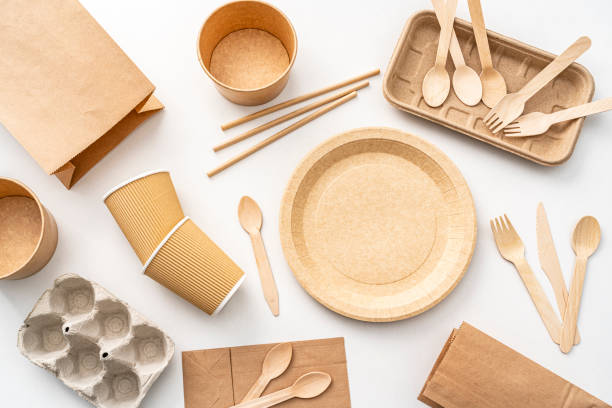

Every celebration leaves a mark. A celebration with single-use plastic loses its appeal once you realize that these plastic plates take centuries to decompose. In the United States, over 40 million tons of disposable plates are used and discarded in landfills every year. The eco-friendly disposables industry helps to ensure that the problem of irresponsible disposable and convenience products does not persist.
Being biodegradable and compostable are not the same
To put it simply. Biodegradable containers break down naturally; however, it can take years. Compostable plates are entirely different.
They turn into compost in 90-180 days, leaving no toxic residue, in 90-180 days. The problem is that manufacturers misuse these terms. Eco-products must get certified. Look for BPI certification or the European EN 13432 standard. Without third-party verification, eco claims are marketing. This is especially critical for bulk purchases, where consumption reaches thousands of units daily
Materials: what modern eco-friendly tableware is made of
The breakthrough came when manufacturers took a fresh look at agricultural waste. Here are the main materials used to make eco-friendly tableware today:
Sugar cane pulp (bagasse)
Previously, it was simply burned, but now it has been turned into sturdy plates. The material can withstand hot dishes up to 95°C and doesn’t get soggy from sauces. These biodegradable containers are ideal for hot dishes.
Palm leaves
Naturally fallen leaves are pressed without chemical additives to produce tableware with a unique pattern. Its strength is impressive — it can even handle heavy steaks and side dishes.
Corn starch (PLA)
Used for transparent cups and cutlery. Unlike conventional plastic, it is produced from renewable sources. There is one caveat: PLA requires a temperature above 60°C to decompose properly, which can only be achieved in industrial facilities.
Bamboo
It grows phenomenally fast — up to a meter per day — and does not require pesticides. Tableware made from it is lightweight, yet very durable. Wood fibers from sustainably managed forests have also found their niche, especially in the production of cutlery.
What to look for when choosing
When choosing eco-friendly tableware, it is important to consider several key factors:
Functionality
Eco-friendliness is of little use if the plate bends under the weight of a salad or the fork breaks when used with chicken. High-quality, eco-friendly tableware can withstand temperatures ranging from -20°C in the freezer to 220°C in the oven. Check whether it can be used in the microwave — this is often necessary for reheating.
Material thickness
Thin plates made of bagasse are suitable for light snacks, but may not be able to handle a main course. Professional lines usually have a thickness of 1.2 to 2 mm — such tableware is reliable for any task.
Aesthetics
This determines the atmosphere of the event. Minimalist white or cream-colored plates made of bagasse are suitable for corporate receptions — they look elegant and modern. Bright options or tableware with the natural texture of palm leaves will decorate a children’s party.
Weddings require special sophistication: transparent PLA glasses with a gold rim or square bamboo plates. Compostable plates allow you to combine style with environmental responsibility.
Composting conditions
Find out in advance: some products are designed for home composting, while others require industrial processing — this is a fundamental difference. If there are no collection points in your city, choose materials that decompose in a regular composter — products made from palm leaves or untreated bamboo.
Value for money
Price should not be a deterrent. Yes, eco-friendly tableware is 20-40% more expensive than plastic alternatives. But when buying in bulk, the difference is reduced to 10-15%. For restaurants and catering companies, this becomes an insignificant expense, especially given the growing demand from customers for eco-friendly solutions.
Selection of assortment for different events
A home party for 20-30 people requires a basic set: dinner plates with a diameter of 23-25 cm, dessert plates 18-20 cm, salad bowls with a volume of 350-500 ml. Add a set of wooden or PLA cutlery — forks, knives, spoons. Glasses with a volume of 300-400 ml and recycled paper napkins will complete the set.
A corporate buffet has higher requirements for presentation. Square plates made of pressed bamboo or snow-white bagasse tableware with embossed edging create the right impression. Mini plates for canapes (12-15 cm in diameter) and elegant wooden skewers add to the atmosphere.
Children’s parties prioritize safety and fun. Choose tableware without sharp edges that is resistant to falls. Plates with dividers will help you serve different dishes for picky eaters. Straws made of corn starch or paper with cheerful prints will add joy without losing functionality.
Outdoor events require special durability. Wind, uneven surfaces, and active games — the tableware must withstand all of this. Deep bagasse bowls with high sides will prevent spillage. Bamboo or wooden cutlery is stronger than plastic and will not break when cutting steak at a picnic.
Large-scale celebrations benefit from a unified serving style. Coordinate the colors of plates, napkins, and tablecloths made from natural materials. Many suppliers offer ready-made sets where everything is thought out to the smallest detail — this saves time and creates visual harmony.
Proper disposal after the event
Composting requires an understanding of the conditions involved. Industrial facilities maintain a temperature of 55-65°C and regular mixing—under these conditions, certified tableware decomposes in 12-20 weeks. Home composting works more slowly (up to six months), but can handle most plant materials.
Set up a convenient sorting system at the event. Install containers with clear labels: “Compostable waste,” “Food scraps.” Visual cues work better than text. For restaurant supplies, such a system is especially important for large volumes.
If there is no industrial composting facility nearby, look for local farmers or gardening cooperatives — many will gladly accept organic waste for their compost piles. Inform guests about your initiative with a short announcement or cards on the tables — people appreciate being part of something meaningful.
The choice that changes the system
Switching to eco-friendly disposable tableware is not a compromise between convenience and responsibility, but rather a harmonious combination of the two. Modern materials have proven their functionality at thousands of events around the world. From family picnics to large-scale corporate parties, there is a solution for every event that will leave no trace for centuries to come.
Every discarded plastic plate will exist for centuries after the memories of the celebration are forgotten. By choosing eco-friendly solutions, you are simply acknowledging the fact that today’s enjoyment should not become tomorrow’s problem. Start small — with one event. The result will speak for itself.
